Fraud Schemes and Financial Crimes
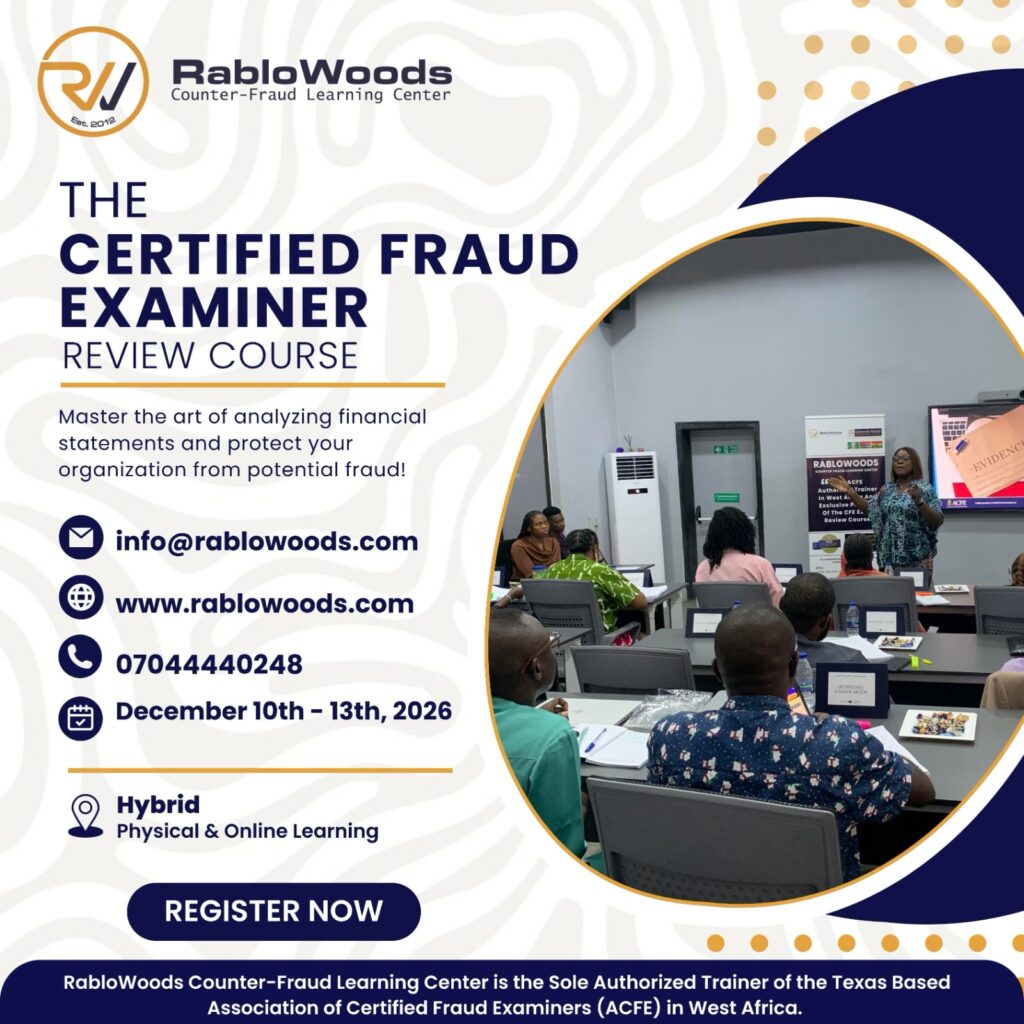
The review course is a 4-day instructor led training where delegates from different organizations attain their CFE credential by mastering the concepts across the three modules and sub-topics of the CFE Exams.
2026 cohort dates.
Hybrid Format
February
25 – 28
Hybrid
June
25 – 28
Hybrid
September
24 – 27
Hybrid
December
10 – 13
Hybrid
Course pricing.
All pricing VAT exclusive. Compare to the standard $4,000 ACFE list value.
$1,500
VAT exclusive
· 4-day instructor-led
· Course materials included
· Lunch & refreshments
· Networking sessions
$1,800
VAT exclusive ·
· 4-day instructor-led
· Course materials included
· Lunch & refreshments
· Networking sessions
$2,000
VAT exclusive
· 4-day live virtual
· Digital course materials
· Q&A and breakout rooms
Built directly to the ACFE syllabus. Each module is taught by Certified Fraud Expert
Accounting Concepts
A solid grasp of accounting fundamentals is the first line of defense against fraud. This module revisits essential accounting principles—such as the accounting equation, double-entry bookkeeping, revenue recognition, and the matching principle—through the lens of fraud detection. You’ll learn how deviations from standard accounting treatments can signal manipulation, how to trace suspicious entries back to source documents, and why seemingly small bookkeeping anomalies often point to larger financial crimes.
Financial Statement Fraud
Financial statement fraud involves the deliberate misrepresentation of a company’s financial position, performance, or cash flows. This module examines common schemes including improper revenue recognition, fictitious sales, concealed liabilities, and improper asset valuation. You’ll analyze real-world cases like Enron and WorldCom, explore red flags such as unusual revenue growth or persistent late adjustments, and learn the frameworks investigators use to uncover earnings management and disclosure fraud.
Asset Misappropriation – Cash Receipts
Cash receipts schemes target incoming funds before they are ever recorded. This module covers skimming, cash larceny, and lapping of accounts receivable. You’ll discover how employees intercept customer payments, delay bank deposits, and manipulate receivables aging to hide theft. Emphasis is placed on identifying internal control weaknesses in the cash collection and recording cycle, as well as audit procedures designed to surface these hidden losses.
Asset Misappropriation – Cash Receipts
Asset Misappropriation – Fraudulent Disbursements
Fraudulent disbursement schemes involve tricking an organization into paying for goods or services that are nonexistent, overpriced, or personal in nature. This module covers billing schemes (shell companies and pass-through invoices), check tampering, payroll fraud, and expense reimbursement abuse. You’ll learn to spot forged endorsements, ghost employees, and inflated expense reports, and understand the segregation-of-duties controls that can prevent payment fraud.
Asset Misappropriation – Inventory and Other Assets.
Not all theft hits the cash account directly. This module focuses on the theft of inventory, supplies, equipment, and other non-cash assets. Topics include false shipping and receiving reports, inventory record manipulation, scrap and waste padding, and outright theft of merchandise. You’ll explore inventory concealment techniques, physical security measures, and analytical reviews such as gross margin analysis and inventory turnover monitoring that help expose missing assets.
Asset Misappropriation – Inventory and Other Assets.
Not all theft hits the cash account directly. This module focuses on the theft of inventory, supplies, equipment, and other non-cash assets. Topics include false shipping and receiving reports, inventory record manipulation, scrap and waste padding, and outright theft of merchandise. You’ll explore inventory concealment techniques, physical security measures, and analytical reviews such as gross margin analysis and inventory turnover monitoring that help expose missing assets.
Corruption
Corruption erodes trust and fair competition from within. This module dissects conflicts of interest, bribery, kickbacks, illegal gratuities, and economic extortion. You’ll examine the classic purchasing agent–vendor kickback cycle, bid-rigging in procurement, and facilitation payments disguised as consulting fees. Special attention is given to the Foreign Corrupt Practices Act (FCPA) and UK Bribery Act, as well as red flags like unexplained wealth, sole-source contracts, and overly cosy vendor relationships
Theft of Data and Intellectual Property
In the information economy, data and trade secrets are as valuable as cash. This module addresses the theft of confidential information, customer lists, proprietary algorithms, and research-and-development data. You’ll learn how departing employees exfiltrate data, how third-party contractors become vectors for loss, and how digital forensics and data loss prevention (DLP) tools can detect and prove intellectual property theft. Legal frameworks around trade secret protection and non-disclosure agreements are also covered.
Theft of Data and Intellectual Property
In the information economy, data and trade secrets are as valuable as cash. This module addresses the theft of confidential information, customer lists, proprietary algorithms, and research-and-development data. You’ll learn how departing employees exfiltrate data, how third-party contractors become vectors for loss, and how digital forensics and data loss prevention (DLP) tools can detect and prove intellectual property theft. Legal frameworks around trade secret protection and non-disclosure agreements are also covered.
Identity Theft
Identity theft fuels a vast underground ecosystem of financial crime. This module explores how fraudsters obtain and use personally identifiable information (PII) to open accounts, file false tax returns, obtain medical care, or commit benefit fraud. You’ll study data breach methods, phishing, synthetic identity creation, and credit-muling operations. The module also discusses red flags on consumer credit reports, victim remediation steps, and the regulatory landscape surrounding identity protection.
Financial Institution Fraud
Banks, credit unions, and other financial institutions face a unique set of insider and external fraud threats. This module covers loan fraud (including mortgage origination and small business lending schemes), wire transfer fraud, new account fraud, insider loan kickbacks, and embezzlement from customer accounts. You’ll examine anti-money laundering (AML) monitoring systems, know-your-customer (KYC) controls, and case studies involving rogue traders and systemic internal control failures.
Money Laundering
Money laundering is the process that transforms illicit proceeds into apparently legitimate funds. This module walks through the three classic stages—placement, layering, and integration—and examines trade-based laundering, real estate laundering, casino and crypto-currency methods, and the use of shell companies and offshore havens. You’ll learn to recognize structuring (smurfing), the role of professional enablers, and the global AML/CFT regulatory regime, including Financial Action Task Force (FATF) recommendations.
Securities Fraud
Securities fraud threatens the integrity of capital markets. This module covers insider trading, market manipulation (pump-and-dump, spoofing, painting the tape), Ponzi and pyramid schemes, offering frauds, and misrepresentation in public filings. Through cases such as Bernie Madoff and Theranos, you’ll explore how fraudsters exploit information asymmetry, the role of securities regulators like the SEC, and the forensic techniques used to trace fund flows and intent in investment scams.
Payment Fraud
As payment systems evolve, so do the schemes that exploit them. This module addresses credit card and debit card fraud, ACH and wire transfer fraud, mobile payment exploits, and P2P platform scams. You’ll examine how account takeover, card skimming, and business email compromise (BEC) result in massive losses, and how technologies like EMV chips, 3D Secure, and behavioral analytics are deployed to combat payment fraud in real time.
Health Care Fraud
Health care fraud preys on the massive flow of funds between providers, insurers, and government programs. This module examines billing for services not rendered, upcoding, unbundling, kickbacks for patient referrals, and medically unnecessary procedures. You’ll study the False Claims Act and whistleblower qui tam actions, learn how data mining identifies aberrant billing patterns in Medicare and Medicaid, and explore pharmaceutical fraud such as off-label promotion and prescription tampering.
Consumer Fraud and Scams
Consumer fraud directly victimizes individuals through deception and manipulation. This module catalogues advance-fee scams, lottery and sweepstakes fraud, romance scams, tech-support fraud, grandparent scams, and deceptive sales practices. You’ll learn the psychological triggers—urgency, authority, social proof—that fraudsters exploit, and examine the challenges of tracing and prosecuting transient, often cross-border scam operations. Consumer education and reporting infrastructure are discussed as critical prevention tools.
Bankruptcy Fraud
Bankruptcy fraud abuses the legal system designed to give honest debtors a fresh start. This module covers concealment of assets, multiple filings using false identities, petition mills, and bribery of trustees. You’ll learn how debtors transfer property to insiders before filing, destroy or falsify records, and how forensic accountants trace hidden assets through lifestyle analysis and public records. The role of the U.S. Trustee Program and bankruptcy examiners is highlighted.
Tax Fraud
Tax fraud is the intentional evasion of legally owed taxes. This module distinguishes civil fraud from criminal tax evasion, and covers underreporting income, claiming false deductions, offshore accounts, abusive tax shelters, and payroll tax fraud. You’ll examine the IRS’s “badges of fraud,” the use of net worth and bank deposit methods to reconstruct income, and the enforcement tools available under the Internal Revenue Code. Payroll tax fraud, where employers withhold but never remit trust fund taxes, receives special attention.
Cyberfraud
Cyberfraud weaponises technology to commit financial crimes at scale. This module covers phishing and spear-phishing, ransomware, business email compromise, credential harvesting, digital payment interception, and cryptocurrency-based fraud. You’ll explore the dark web marketplace for stolen data, the anatomy of a social engineering attack, and the investigative techniques used in computer forensics, including IP tracing, malware analysis, and the use of blockchain analytics to follow illicit crypto flows.
Government and Public Sector Fraud
Public funds invite unique fraud risks rooted in entitlement programs, grants, and contracts. This module examines fraud in unemployment insurance, public benefits programs, disaster relief funds, and federal grants. You’ll look at false claims submitted by contractors, collusion between public officials and vendors, and payroll fraud involving ghost workers on state rolls. The module also addresses the role of inspectors general, whistleblower protections, and the use of data analytics to uncover anomalies in public expenditure.
Take the first step in becoming a Certified Fraud Examiner.
Specialized services tailored to client needs across financial services, oil & gas, and maufacturing, and telecommunications. Backed by 60+ senior consultants and 100+ years of combined experience.