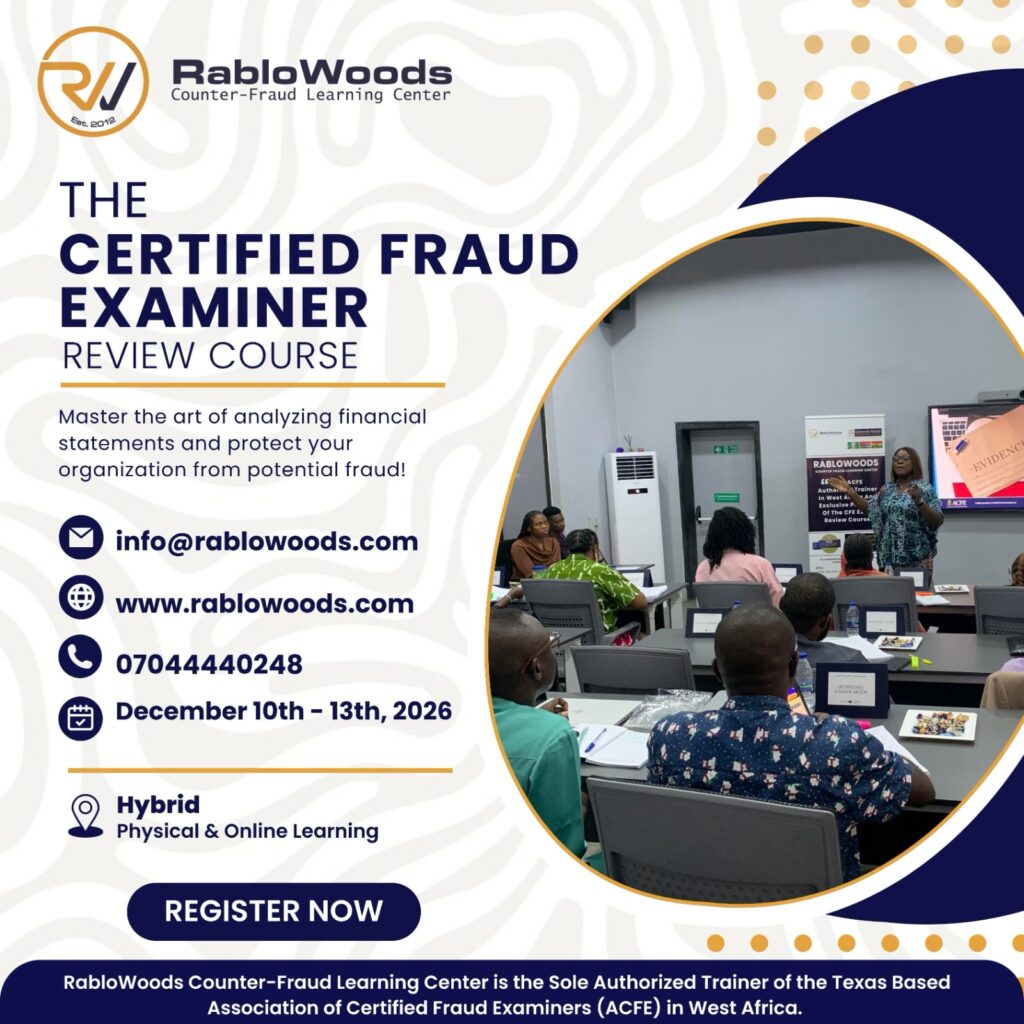
The review course is a 4-day instructor led training where delegates from different organizations attain their CFE credential by mastering the concepts across the three modules and sub-topics of the CFE Exams.
2026 cohort dates.
Hybrid Format
February
25 – 28
Hybrid
June
25 – 28
Hybrid
September
24 – 27
Hybrid
December
10 – 13
Hybrid
Course pricing.
All pricing VAT exclusive. Compare to the standard
$4,000 ACFE list value.
$1,500
VAT exclusive · Lagos venue
· 4-day instructor-led
· Course materials included
· Lunch & refreshments
· Networking sessions
$1,800
VAT exclusive · Accra venue
· 4-day instructor-led
· Course materials included
· Lunch & refreshments
· Networking sessions
$2,000
VAT exclusive · Live online
· 4-day live virtual
· Digital course materials
· Q&A and breakout rooms
Built directly to the ACFE syllabus. Each module is taught by Certified Fraud Expert
Planning and Conducting a Fraud Examination
Every successful fraud examination begins with a structured, hypothesis-driven plan. This module covers the entire engagement lifecycle: initial triage and allegation assessment, engagement letters, scoping the investigation, assembling the team, budgeting, and defining objectives. You’ll learn how to design an investigation roadmap that preserves privilege, maintains confidentiality, and dynamically adapts as new evidence emerges—all while working within resource constraints and the constant threat of spoliation.
Legal Issues in Conducting Investigations
A technically perfect investigation can be rendered useless if legal boundaries are crossed. This module addresses the rights of employees and subjects, privacy laws, workplace monitoring, data protection regulations, and the attorney-client privilege and work-product doctrine. You’ll examine the critical distinction between an internal fact-finding probe and an investigation directed by counsel, and learn to avoid traps such as defamation claims, false imprisonment, and breaches of electronic communication privacy laws.
The Law Related to Fraud
This module maps the legal terrain that defines what makes a deceptive act a prosecutable fraud. You’ll study the core elements of criminal and civil fraud (material false statement, knowledge of falsity, intent to deceive, reliance, and damages), and examine the major statutes: mail fraud, wire fraud, bank fraud, securities fraud, the False Claims Act, and the RICO statute. The module places each law in a practical context, showing how charging decisions are made and how an investigator’s evidence must align with statutory elements.
Basic Principles of Evidence
Evidence is the only language a court or tribunal understands. This module introduces relevance, materiality, admissibility, weight, credibility, and the difference between direct and circumstantial evidence. You’ll learn the rules concerning hearsay and its exceptions, the authentication of documents and digital records, the chain of custody, and the role of judicial notice. A strong foundation in evidentiary principles ensures that the facts you gather survive legal scrutiny and stand up under cross-examination.
Collecting Evidence
Gathering proof while preserving its integrity is both art and science. This module covers documentary evidence collection (original vs. copies, subpoenas, voluntary production), physical evidence handling, and the forensic imaging of digital devices. You’ll learn best practices for search protocols, seizure of assets, working with digital forensic specialists, and managing the chain of custody log. Emphasis is placed on procedures that prevent spoliation, maintain the record’s admissibility, and survive courtroom challenges.
Data Analysis and Reporting Tools
Modern investigations run on data, and mastering the tools is non-negotiable. This module surveys the analytical techniques and software used to detect and visualize fraud: Benford’s Law analysis, pattern recognition, fuzzy matching for duplicate payments, link analysis (e.g., i2, Palantir), email threading, and timeline visualizations. You’ll learn to transform raw transactional data into compelling exhibits and understand how data analytics can both reveal hidden relationships and massively accelerate an examination.
Sources of Information
Investigators must know where to look. This module catalogs internal sources (accounting systems, email archives, HR files, access logs) and external sources (public records, commercial databases, social media, regulatory filings, credit reports, and open-source intelligence). You’ll learn the lawful methods for accessing and leveraging these repositories, how to perform background checks on subjects and entities, and the art of using transactional records and metadata to reconstruct events without ever stepping out of the office.
Tracing Assets
Once a scheme is proven, the next question is where the money went. This module teaches the “follow the money” methodology: reconstructing fund flows through bank records, brokerage accounts, real estate purchases, shell company transfers, and cryptocurrency wallets. You’ll examine the books-and-records and bank-deposit methods of tracing, learn to pierce layers of nominee ownership, and understand how lifestyle analysis and net worth calculations can expose hidden assets even when the paper trail goes cold.
Interview Theory and Application
Interviewing is the investigator’s most delicate and powerful tool. This module covers the full spectrum of non-confrontational interviews: rapport building, cognitive interview techniques, question typology (open, closed, leading), active listening, and detecting deception through verbal and non-verbal cues. You’ll learn to sequence interviews strategically, take effective notes without breaking flow, handle reluctant or emotional witnesses, and create an environment that maximises the free flow of reliable information.
Admission-Seeking Interviews
This module focuses on the final, most high-stakes encounter: seeking a confession. You’ll study the legal and psychological prerequisites for an admission-seeking interview, including timing, setting, and the steps for establishing rationalisation. Specific techniques—such as confronting the subject with evidence incrementally, managing denial patterns, using alternative questions, and converting an oral admission into a legally sufficient, voluntary written confession—are examined in detail. Particular attention is paid to avoiding coercion, preserving the subject’s rights, and ensuring the interview withstands a voluntariness challenge.
Covert Operations
When overt investigation is impossible or would compromise the case, covert methods may be necessary. This module covers undercover operations, physical and electronic surveillance, controlled deliveries, and covert online personas. You’ll learn the legal frameworks governing consent recordings, one-party vs. all-party consent jurisdictions, and the limits on entrapment. Practical topics include operational planning, maintaining agent safety, evidence logging in real time, and the controlled exit from an undercover assignment.
Report Writing
An investigation is only as good as its final report. This module teaches you to assemble findings into a clear, objective, chronological document suitable for management, boards, regulators, law enforcement, or courts. You’ll learn to structure the report, present evidence logically, distinguish facts from inferences, and use appendices and visual aids effectively. Emphasis is placed on precision of language, the avoidance of legal conclusions, managing privilege designations, and writing with the constant awareness that every sentence may be read aloud in a deposition or trial.
Overview of the Legal System
Fraud investigators must navigate the legal system with confidence. This module explains the structure of the courts, the differences between civil and criminal actions, the stages of a lawsuit (pleadings, discovery, trial, appeal), and the roles of judges, juries, and magistrates. You’ll also learn about alternative forums such as arbitration and administrative hearings, the concept of jurisdiction, and how the burden and standard of proof shift dramatically between a civil trial (preponderance of the evidence) and a criminal prosecution (beyond a reasonable doubt).
Criminal Prosecutions
This module traces a fraud case from criminal referral to sentencing. You’ll examine how law enforcement agencies and prosecutors’ offices assess referrals, the grand jury process, filing of charges, plea bargaining, the discovery process (including Brady material), trial procedure, and sentencing guidelines. Key topics include the rights of the accused, the role of the investigator as a witness, parallel proceedings, and the practical realities of seeking restitution for victims within the criminal justice framework.
Non-Criminal Actions
Criminal prosecution is not the only remedy, nor always the best. This module covers the civil avenues for fraud recovery and accountability: civil lawsuits for fraud, breach of fiduciary duty, and conversion; prejudgment attachments and asset freezes; permanent injunctions; and regulatory enforcement actions by bodies such as the SEC, FCA, or FTC. You’ll also explore administrative sanctions, professional license revocations, and the strategic use of civil discovery to obtain evidence that can later support a criminal referral.
Testifying
Every investigation can culminate in testimony. This module prepares you to be an effective and unshakable witness, whether in deposition, at trial, or before a regulatory panel. You’ll learn the rules of expert versus fact witnesses, the preparation of affidavits and expert reports, and the techniques for surviving cross-examination: listening carefully, answering only what is asked, remaining calm under pressure, and never guessing. Through mock testimony scenarios, you’ll develop the ability to explain complex financial evidence in plain, persuasive language that a judge or jury can trust.
Tell us about your fraud risk
priorities.
A short call is enough to scope the right service for your organization, whether that is a certification path, a tailored training
program, or a forensic engagement.