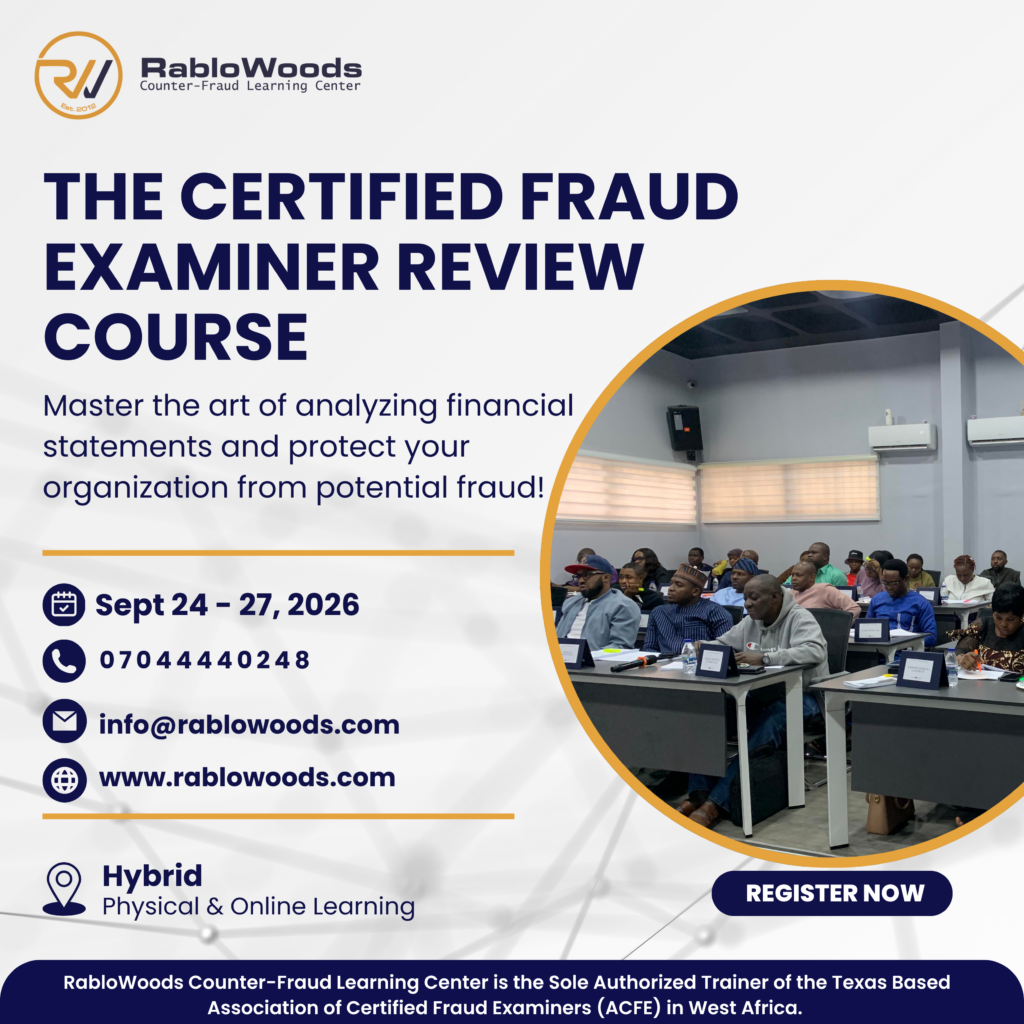
The review course is a 4-day instructor led training where delegates from different organizations attain their CFE credential by mastering the concepts across the three modules and sub-topics of the CFE Exams.
2026 cohort dates.
Hybrid Format
February
25 – 28
Hybrid
June
25 – 28
Hybrid
September
24 – 27
Hybrid
December
10 – 13
Hybrid
Course pricing.
All pricing VAT exclusive. Compare to the standard $4,000 ACFE list value.
$1,500
VAT exclusive
· 4-day instructor-led
· Course materials included
· Lunch & refreshments
· Networking sessions
$1,800
VAT exclusive ·
· 4-day instructor-led
· Course materials included
· Lunch & refreshments
· Networking sessions
$2,000
VAT exclusive
· 4-day live virtual
· Digital course materials
· Q&A and breakout rooms
Built directly to the ACFE syllabus. Each module is taught by Certified Fraud Expert
Understanding Financial Crime
Prevention begins with comprehension. This module explores the ecosystem of financial crime, its root causes, and its staggering economic and social impact. You’ll examine the Fraud Triangle (pressure, opportunity, rationalization) and the Fraud Diamond (adding capability), and learn to categorize offenses by perpetrator type: internal occupational fraud, external consumer fraud, and organized criminal enterprise. The module also contrasts the cost-effectiveness of prevention against the much higher expense of investigation and remediation, laying the philosophical foundation for a proactive anti-fraud posture.
Corporate Governance
Strong governance is the structural backbone of fraud deterrence. This module examines the roles and responsibilities of the board of directors, audit committee, compensation committee, and executive leadership in setting the ethical tone at the top. You’ll analyze how governance failures create opportunity, study landmark cases where board passivity allowed fraud to flourish, and learn the principles of effective oversight: independence, access to information, transparent reporting lines, and a culture that empowers challenge. The concept of the “tone at the top” is dissected into observable behaviors and enforcement mechanisms.
Management’s Fraud-Related Responsibilities
Management owns the internal control environment that makes fraud either easy or nearly impossible. This module details management’s duties under frameworks like the Committee of Sponsoring Organizations (COSO) and various regulatory regimes: designing and implementing controls, assessing and disclosing fraud risks, and demonstrating an unwavering commitment to integrity. You’ll study how senior leaders can inadvertently condone fraud through unrealistic performance targets, override of controls, or indifference to red flags, and learn the specific responsibilities for certifying financial statements and maintaining an effective anti-fraud program.
Auditors’ Fraud-Related Responsibilities
While management holds primary ownership, external and internal auditors play a critical detective and deterrent role. This module clarifies the expectations defined by auditing standards (ISA 240 / SAS 99 / AS 2401), including professional skepticism, brainstorming sessions to identify fraud risks, and mandatory responses when material fraud is suspected. You’ll explore the expectations gap between what the public believes auditors should find and what an audit is actually designed to detect, the concept of materiality in a fraud context, and the auditor’s communication obligations to management and those charged with governance.
Fraud Prevention Programs
A fraud prevention program transforms abstract anti-fraud sentiment into concrete, daily action. This module walks you through the design and implementation of a comprehensive, organization-wide program. Topics include the development of a formal fraud policy, employee codes of conduct, whistleblower hotlines, pre-employment and periodic background screening, segregation of duties, mandatory vacations, and job rotation. You’ll learn how to create a visible, pervasive anti-fraud control structure that increases the perception of detection—one of the most powerful deterrents known—and how to embed preventive controls into business processes rather than bolting them on.
Fraud Risk Assessment
Risk assessment identifies the threat; risk management responds to it. This module moves from theory to action, covering the development of targeted fraud control strategies. You’ll learn the four classic risk responses—accept, avoid, reduce, and transfer—specifically applied to fraud. Key topics include implementing detective controls (continuous monitoring, surprise audits, data matching) to complement preventive ones, developing key risk indicators (KRIs) and dashboards, establishing incident response and remediation protocols, and creating a feedback loop where detected incidents strengthen risk assessment. The module treats fraud risk management as a continuous, iterative lifecycle.
Fraud Risk Management
Investigators must know where to look. This module catalogs internal sources (accounting systems, email archives, HR files, access logs) and external sources (public records, commercial databases, social media, regulatory filings, credit reports, and open-source intelligence). You’ll learn the lawful methods for accessing and leveraging these repositories, how to perform background checks on subjects and entities, and the art of using transactional records and metadata to reconstruct events without ever stepping out of the office.
Tracing Assets
Once a scheme is proven, the next question is where the money went. This module teaches the “follow the money” methodology: reconstructing fund flows through bank records, brokerage accounts, real estate purchases, shell company transfers, and cryptocurrency wallets. You’ll examine the books-and-records and bank-deposit methods of tracing, learn to pierce layers of nominee ownership, and understand how lifestyle analysis and net worth calculations can expose hidden assets even when the paper trail goes cold.
Ethics for Fraud Examiners
Fraud examiners themselves must operate from an unassailable ethical foundation. This module confronts the ethical dilemmas unique to the profession: confidentiality, conflicts of interest, the limits of client advocacy, and the obligation to report findings even when they are unwelcome. You’ll study the Certified Fraud Examiner (CFE) Code of Professional Ethics, learning to resolve situations where legal, professional, and personal obligations appear to collide. Scenarios dealing with client pressure to alter findings, the receipt of privileged information, and the duty to correct mistakes are examined to build a decision-making framework rooted in integrity, objectivity, and professional responsibility.
Take the first step in becoming a Certified Fraud Examiner.
Specialized services tailored to client needs across financial services, oil & gas, and maufacturing, and telecommunications. Backed by 60+ senior consultants and 100+ years of combined experience.