Your questions answered
This course is built for a broad range of professionals who encounter fraud risk in their roles: internal and external auditors, compliance officers, forensic accountants, risk managers, law enforcement personnel, legal professionals, and anyone seeking the Certified Fraud Examiner (CFE) credential or a deeper understanding of financial crime. The material is structured to benefit both those new to fraud examination and experienced practitioners looking to formalize and update their knowledge.
No specific prerequisite is required, though familiarity with basic business processes and financial statements is helpful. The course begins with a dedicated module on essential accounting concepts, and legal topics are introduced from first principles. Participants from non-accounting backgrounds—such as IT security, human resources, or operations—regularly succeed by engaging with the foundational modules and practical exercises.
The curriculum is organized into three integrated pillars:
Fraud Schemes and Financial Crimes – the full taxonomy of occupational fraud, corruption, cybercrime, and consumer scams.
Fraud Investigations and Legal Issues – planning examinations, collecting evidence, interviewing, tracing assets, the legal framework, and testifying.
Fraud Prevention and Deterrence – governance, fraud risk management, prevention programs, and professional ethics.
This structure reflects the body of knowledge of the CFE exam and real-world fraud-fighting practice.
The syllabus directly aligns with the four sections of the CFE Exam: Financial Transactions and Fraud Schemes, Law, Investigation, and Fraud Prevention and Deterrence. Each module maps to exam topics, and the materials reinforce the concepts, terminology, and reasoning skills tested. Many participants use this course as their primary preparation resource before sitting for the exam.
Yes. The course draws on extensively documented real-world fraud cases—from asset misappropriation and financial statement fraud to complex money laundering and cybercrime schemes. Lessons are illustrated with sanitized examples drawn from actual investigations, regulatory actions, and court records, allowing you to see how theoretical concepts are applied in practice and how red flags manifest in real organizations.
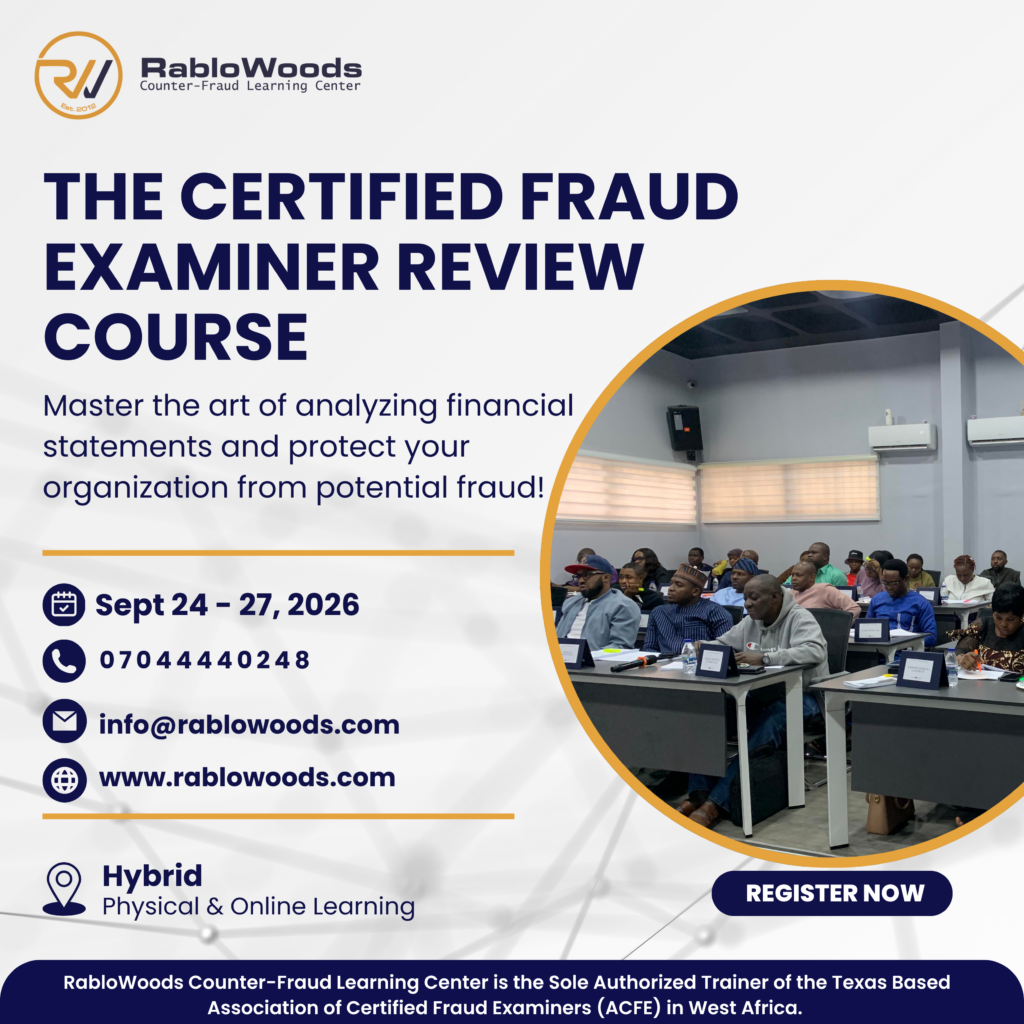
Reserve your seat for the next
cohort.
Sept 24 -27, 2026. Hybrid sessions in Lagos with virtual access
globally.